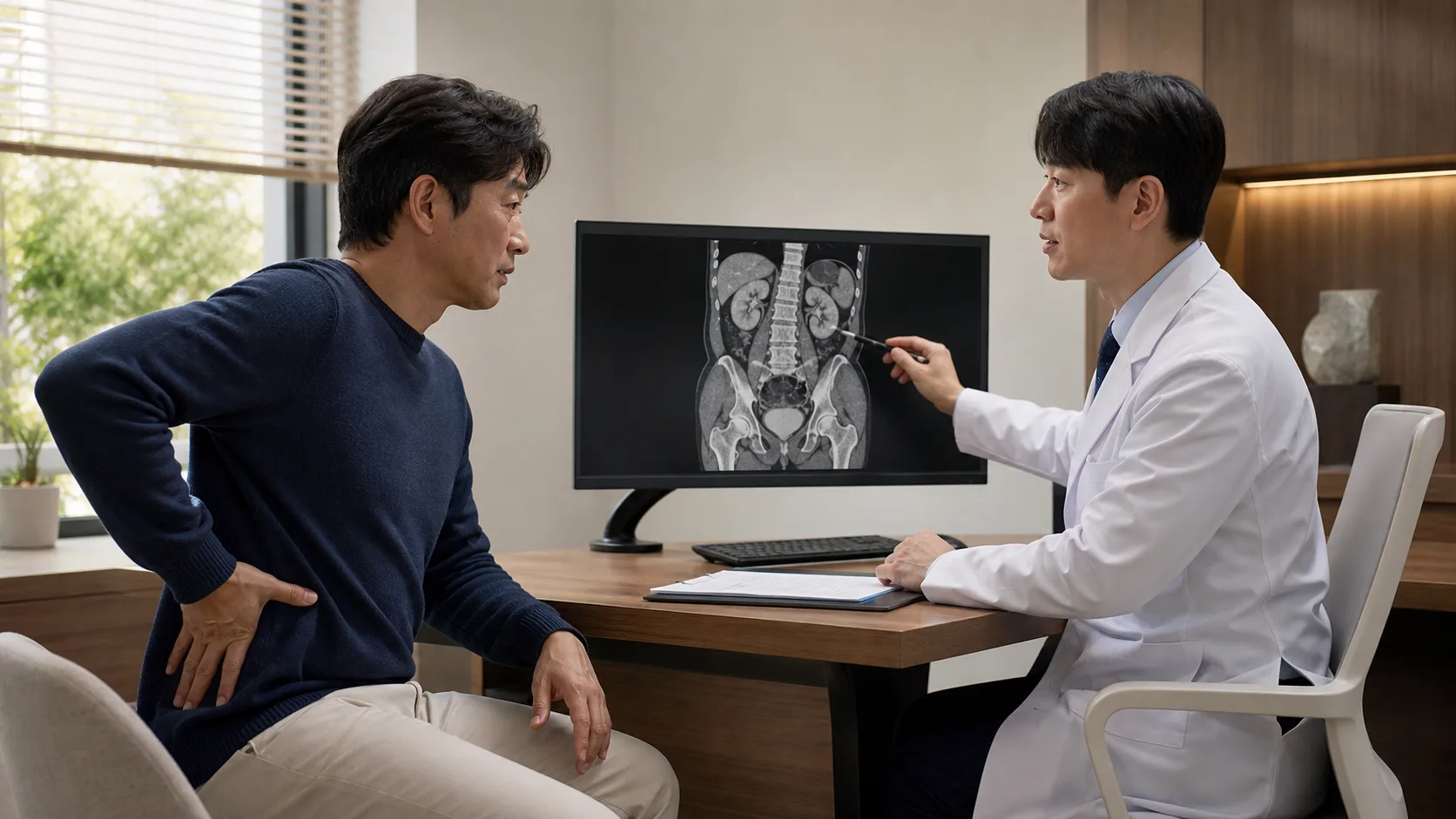
After hearing that you have a stone, you may think, “Can’t it simply be broken up from outside the body?” Extracorporeal shock wave lithotripsy offers an approach without an incision, but it is not equally suitable for every stone.
If ureteroscopy has been recommended, ask which findings in your tests influence the choice. Understanding the stone’s location, urine flow, and the conditions for safe removal comes before the treatment name.
The cover and inline images are AI-generated to aid understanding. Consultation scenes do not show actual patients or real clinical records. Props and educational models are illustrative and do not represent a specific device or test result.
Breaking a Stone From Outside Versus Reaching It Directly

Shock wave lithotripsy sends shock waves from outside the body to break a stone into small pieces. Those fragments then need to pass through the urinary tract. Ureteroscopy introduces an instrument through the urethra toward the bladder and ureter to reach the stone directly. The scope and extent of treatment depend on the location and plan. European Association of Urology patient guide to shock wave lithotripsy
Do not take “no incision” to mean no burden. Even treatment from outside the body requires attention to pain, bleeding, and the passage of fragments. Endoscopic treatment also involves discussing anesthesia, infection, ureteral injury, and possible discomfort related to a stent. NHS guide to kidney stone treatment
Ask about the goals of the two approaches separately. Questions such as “Why do you expect shock waves to break up my stone well?” and “Why are you considering direct removal by a scope?” connect the explanation to your own test results.
Location and Hardness Matter Alongside Size

Stone size is important, but it does not determine treatment on its own. The clinician also considers whether the stone is in the kidney or ureter, whether it lies in the lower part of the kidney, and the route urine takes. Density on imaging and the distance from the skin to the stone may help estimate the response to lithotripsy. European Association of Urology guideline on urinary stones
Do not reach a conclusion simply by entering a measurement from your report into an online chart. Stones of the same size may have different conditions for passage. “The stone is small” is not the same as “It is appropriate to observe it now.” Symptoms, infection, obstruction, and kidney function also need assessment.
When your results are explained, you can ask the clinician to point out the location. If initial and recent results are available, check whether size or position has changed. If the treatment choice has changed, ask whether the reason is a change on testing or the response to the first treatment.
Compare the Chance of One Treatment and the Burden of Repeated Care

Shock wave lithotripsy may require more than one session, and remaining fragments may lead to consideration of another treatment. Ureteroscopy can also require further treatment or staged procedures. Neither method guarantees completion in a single session. NHS guide to the treatment process
Alongside “How many treatments might I need?”, ask “Which tests will guide the next treatment decision?” If repeated lithotripsy is expected, establish follow-up dates and whom to contact for pain between sessions. If an endoscopic procedure is planned, ask whether you will need a stent and, if so, when it will be removed.
If work scheduling is tight, consider more than the hours spent at treatment. Put transport home and the next appointment on your calendar too. Restrictions on driving after anesthesia and advice about daily activity depend on the care actually provided. For costs, ask under what circumstances additional tests or procedures could be needed rather than comparing only the first treatment fee.
Assess Infection and Bleeding Risks Before Treatment

Priorities change when a stone is accompanied by infection and an obstructed urinary tract. Emergency drainage of urine and antibiotic treatment may be needed, with definitive stone removal planned after the infection is controlled. European Association of Urology guidance on infected obstruction
Medication also affects treatment selection. If you take an anticoagulant or antiplatelet medicine, report its name and why it was prescribed. The relevant clinicians decide on interruption or an alternative plan after weighing bleeding and clotting risks. Do not stop medication yourself or assume that pausing it for a few days is enough.
Provide all information your team asks about, including recent fever, urine test results, previous infections, and the possibility of pregnancy. If you develop new symptoms, contact the team beforehand rather than first mentioning them on arrival for treatment. Pre-treatment checks assess the safety conditions for the choice; they are more than a formality.
Distinguish Expected Discomfort From Symptoms Needing Prompt Care

Once home, follow your individual instructions for medication, fluid intake, and activity. Passing fragments may cause discomfort, but not every pain should be dismissed as a normal part of passage. Worsening pain or pain that cannot be controlled is a reason to contact your team. NHS guide to kidney stone symptoms
If you have fever and chills, cannot urinate, have persistent vomiting, or severe pain, seek prompt assessment rather than waiting for the scheduled appointment. Do not replace medical care by drinking excessive water or exercising to force the stone out. If kidney or heart disease has led to a fluid restriction, tell the treating team about that advice too.
If you have a stent after ureteroscopy, confirm the expected range of discomfort and the removal date. At home, it can be difficult to determine whether symptoms come from the stent, infection, or another problem. Establish whom to contact for new changes before discharge.
The Plan Includes Your Next Test

Do not assume that all stones are gone simply because the pain has disappeared. Imaging and your course of recovery help assess remaining fragments and urine flow. The follow-up method and timing are individualized. European Association of Urology guideline on stone follow-up
Before choosing treatment, note the following:
- Why this treatment is preferred for your stone’s location and size
- The criteria for deciding whether further treatment is needed
- Advice on anesthesia, getting home, and returning to work
- Whether stent insertion and removal are needed
- The next imaging date and contact details if symptoms worsen
For more about remaining fragments, see our guide to residual stones and follow-up after lithotripsy. Treating the current stone and preventing recurrence are separate tasks. Ask whether analysis of a passed fragment or a later prevention consultation is appropriate.