If changing medication still does not produce a satisfactory erection, you may begin to consider penile implant surgery. One of the first questions that comes up while searching is, “What will change after surgery?” Are firmness, sexual desire, sensation, and size all the same issue?
During your consultation, it helps to separate the changes you hope for. This article discusses penile implant surgery for erectile dysfunction. For an overview of the procedure, see our existing guide to inflatable penile implants.
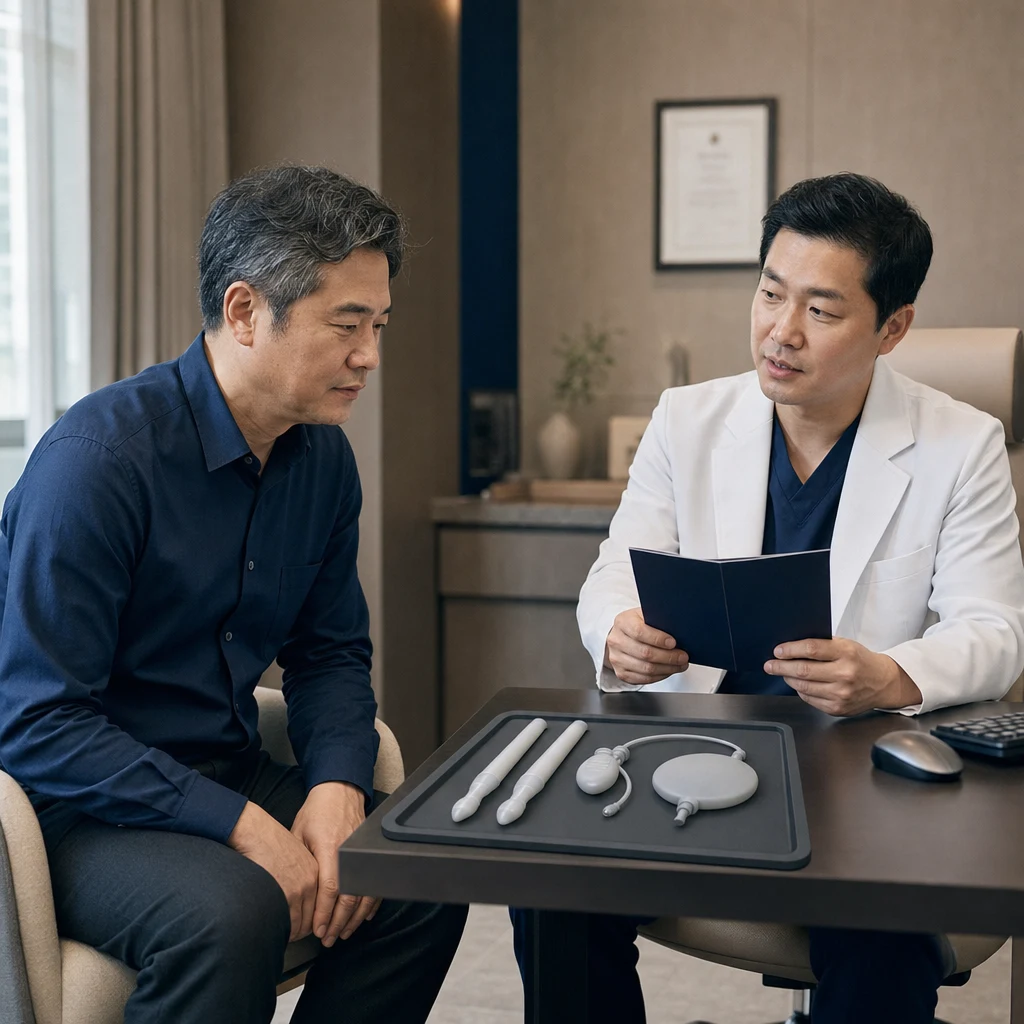
The cover and inline images are AI-generated to aid understanding. Consultation scenes do not show actual patients or real clinical records. Props and educational models are illustrative and do not represent a specific device or test result.
Start by Reviewing Previous Treatment and Your Current Health

If you have booked a surgical consultation, summarize the treatments you have received on one sheet. Write down the medication names, how you took them, the response, and any problems. Describing the conditions in which you used a medicine gives the conversation a more useful starting point than simply saying, “It did not work.” Include your experience with injections or a vacuum device, if you have tried them.
An implant is one of several options for erectile dysfunction. Discuss whether less invasive treatments are appropriate, any reasons you cannot use them, and your personal preferences. Tell your clinician about diabetes, cardiovascular disease, previous pelvic surgery, and current medications. European Association of Urology guideline on erectile dysfunction
You can begin with three questions: “Why are we considering surgery in my case?”, “Is there room to try other options?”, and “What preparation does my current health require?” Before choosing a surgery date, check whether you can explain the reasons for the choice in your own words.
Ask Separately About Firmness, Desire, and Sensation

An implant is a device that mechanically creates penile firmness. If you understand it as a treatment that increases desire or resolves every sexual-function concern at once, your expectations may not match its role. First explain whether your desire is low, you can achieve but not maintain an erection, or you have pain or altered sensation. Mayo Clinic guide to penile implants
You can ask about sensation, orgasm, and ejaculation individually. Surgery does not create these functions anew; your preoperative condition and underlying causes also matter. For example, if you have had prostate surgery, explain your current ejaculation function so that you do not expect an implant to reverse a change that has already occurred.
Instead of asking only, “Will it be normal?”, write down what matters most to you. The discussion will differ depending on whether your priority is firmness for intercourse, the burden of preparing to use a device, or communication with your partner. If you would like your partner to hear the explanation too, you can discuss that arrangement according to your wishes.
Do Not Expect the Procedure to Increase Size

Using penile implant surgery and penis-enlargement surgery to mean the same thing creates confusion. An implant for erectile dysfunction aims to provide firmness; it is not a device for making the penis larger than it is at the time of surgery. Discuss in advance that your perception of length after surgery may differ from your expectations. Mayo Clinic guidance on expectations before surgery
Remembering past erections and comparing their size with your current condition cannot reliably predict the surgical outcome. Your clinician will assess how long erectile dysfunction has been present, curvature or fibrosis, and previous surgery. Rather than relying on an online promise of a particular length or girth, ask what is possible after an examination.
Before surgery, consider asking, “What changes can I expect with my current condition?”, “How does swelling of the glans differ from the firmness created by the device?”, and “Which of my expectations need adjusting?” Understanding both the device and your physical condition is more useful than choosing a single target measurement.
Compare the Practical Steps of Operating Each Device

Device selection involves more than a name and a diagram. An inflatable device requires operating a pump, while a malleable device is repositioned. If hand strength or joint movement is difficult, first ask how you will learn to use the device. European Association of Urology guidance on implant selection
If a demonstration model is available, you can review the operating sequence with your clinician. Avoid practicing on an implanted device on your own based only on online videos. When training can begin after surgery depends on wound healing and the treating clinician’s plan.
When choosing a device, discuss whether it suits daily life, whether you understand that it is managed inside your body rather than simply stored or prepared externally, and whom to contact if it becomes difficult to operate. Having time to ask questions during training is part of the decision too.
Discuss Infection, Device Failure, and Possible Further Surgery

Implant surgery places a device inside the body and is irreversible. Do not assume that removing the device would restore your original natural erections. Make sure this is explained fully before surgery. Risks include infection, tissue injury, and mechanical failure; problems may require surgery to remove or replace the device. A promise of trouble-free use for life is not a sound basis for a decision. Mayo Clinic guidance on risks
Before surgery, ask about your individual risk factors and preparation. Check whether blood glucose needs attention, whether there are symptoms suggesting a current infection, and how medications should be managed. Taking antibiotics on your own or stopping anticoagulants without medical advice is not appropriate preparation.
Before discharge, establish whom to contact if pain worsens, you develop a fever, the wound changes, or the device seems to be becoming exposed. Apart from the scheduled follow-up, ask specifically which new symptoms should prompt contact. Returning to normal activities and intercourse is determined after checking your individual recovery.
Six Questions to Review Before Signing Consent

At the end of the consultation, briefly review what you have heard: why surgery is being considered, the device type and operating method, the function you can expect, improvements that are not guaranteed, recovery timing, and long-term follow-up. Ask again about anything you do not understand before giving consent.
- What about the cause of my erectile dysfunction and my response to previous treatment supports considering surgery?
- Which device suits my hand function and daily life?
- What should I expect separately for firmness, sensation, ejaculation, and size?
- What assessment and treatment would I need if infection or device failure occurred?
- When will device training and the return to intercourse be reviewed?
- What do surgery, admission, and follow-up cover, and under what circumstances could additional costs arise?
These questions are preparation for understanding your goals and the burdens you are willing to accept, rather than a checklist for rushing into surgery. General information cannot determine your suitability. Base your decision on an examination and explanation tailored to your condition.